
Project 01 · Master thesis
Virtual Prosthesis Trainer In progress
A myoelectric prosthesis is hard to learn, and training usually starts only after the socket is made. This system lets a patient practise earlier, at home, with a virtual prosthetic hand mounted on their own limb scan.
- Real-time pipeline: band signals → filtering → features → per-user LDA classifier → virtual hand over WebSocket
- Camera hand tracking copies every finger and the wrist, and labels training data automatically
- Detects 8 grip types (power, pinch, tripod, key grip, point and more) from 3D hand geometry
- One Euro filtering removes jitter without adding lag
- Grasp-and-place game logs success rate, grab time and release time for every session
- Records and replays hand movements for therapist review


GameplayRecorded with camera tracking · blue band = sensor band position
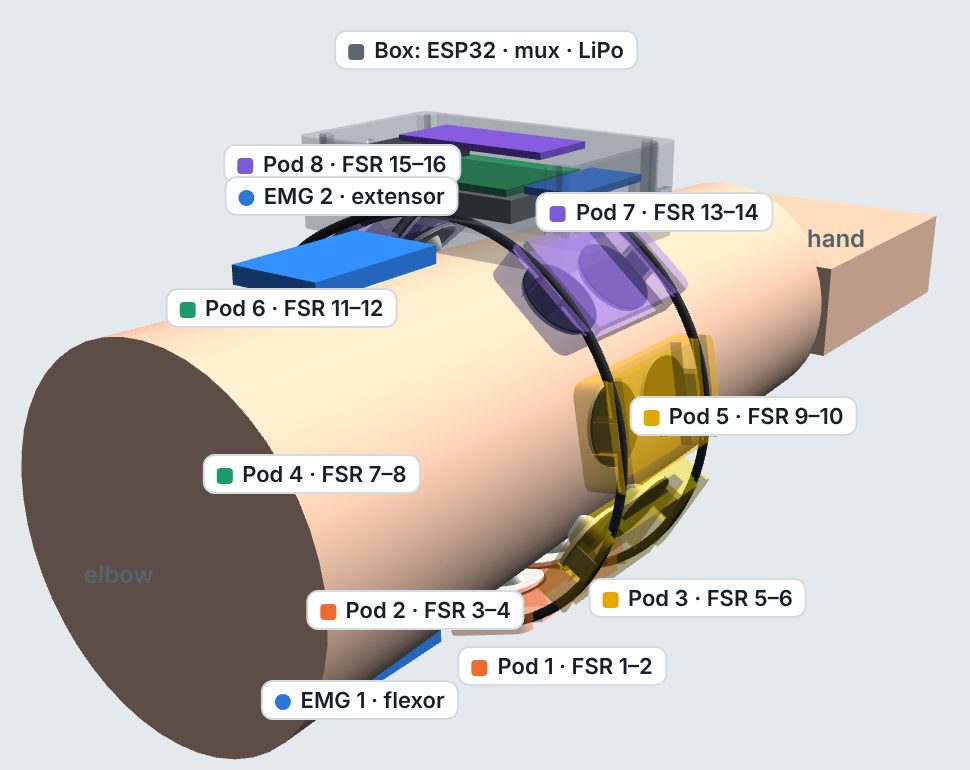
The sensor band
A 3D-printed band worn on the forearm below the elbow. 16 pressure sensors (FMG) feel how the muscles change shape, 2 EMG sensors read the electrical activity of the finger flexors and extensors, and a wireless ESP32 sends everything to the trainer.
- Wear the band. The patient puts the band on the residual limb and opens the trainer on a laptop.
- Teach the AI. The patient tries a fist, a pinch, an open hand, a few seconds each. A small classifier learns this person's own muscle pattern.
- Move the virtual hand. The band streams wirelessly, the AI decodes the intended grip, and the virtual prosthetic hand on the patient's own limb scan opens and closes in real time.
- Train with games. Fruit basket, tower and matching games practise grasp, carry and release, and log success rate and grab and release time, so the therapist sees progress before the real socket is ready.
Today a camera and a blue marker band stand in for the sensors (videos above); the printed band replaces them next.
Open the 3D band ↗

